Nokia 6 review


he last time you could buy a phone with the word Nokia imprinted on it in the US, Barack Obama was a mere two years into his second term as president, the Chicago Cubs still hadn’t managed to break their century-long dry spell in the World Series, and Apple had yet to sell a single smartwatch.
But despite the non-existence of Nokia phones in America for almost three years, the brand is back, albeit not quite the same as before. A lot has changed since the last time Nokia was here. This new Nokia phone doesn’t even run the same software platform it did years ago. And this new phone — the Nokia 6, available exclusively through Amazon — isn’t a high-end device with cutting-edge design or a game-changing camera.
Instead, the Nokia 6 is an entry-level device with an entry-level price to match. Its $229 price drops to $179.99 if you opt for Amazon’s version that’s loaded with Amazon apps and ads. For that cost, you get an unlocked Android phone with a 5.5-inch, 1080p screen, a 16-megapixel camera, and Qualcomm’s entry-level processor. Basically, there’s nothing here, save for the logo that calls back to Nokia’s glory days.
But is the Nokia 6 a worthwhile phone on its own? Yes, especially if you opted for the Amazon version and got it for less than $200. Nothing about the Nokia 6 will give you the impression that you’re using a more expensive or premium device, but it’s a reliable phone that should last a couple of years, provided your needs aren’t that demanding
There are a lot of phones in the Nokia 6’s price range now, and many of them share the same basic specs. The 6 doesn’t veer too far from the norm. Its 5.5-inch display is large and sharp enough, though not as bright or colorful as a more expensive device. It has 32GB of storage, a slot for a microSD card, and 3GB of RAM. The 1.4GHz Qualcomm Snapdragon 430 processor is adequate for day-to-day use, but push the Nokia 6 hard with a lot of multitasking or gaming and you’ll see it show signs of struggle under the load. Similarly, the battery will last a full day for most people, but more demanding users will probably have to hit the charger in the evening.
The Nokia 6’s design also speaks to its budget positioning. It is a metal unibody phone, but the edges are sharp and blocky, and it doesn’t feel particularly polished or refined. The large bezels around the screen and Micro USB charging port give the whole experience a very 2015 vibe.
I never expect much from a phone’s camera at this price point, and the 6 doesn’t do anything to change that. The 16-megapixel camera is slow to launch and focus, and while it can take okay photos in good lighting, image quality falls apart in low lighting.
Most people will probably buy the Nokia 6 with Amazon’s experience, which saves a not-insignificant $50 from the price of the phone for Prime members and brings along lock screen ads and Amazon’s suite of apps preinstalled.
The 10 preinstalled Amazon apps don’t bother me all that much. I’d be installing Amazon’s shopping app anyway, and if you’re a Prime member, the Photos, Prime Video, and Amazon Music apps are likely to be useful to you.
The ads, which appear on the lock screen and in the notification tray of the phone, are a bit more annoying. Like many other phones, the Nokia 6 has a fingerprint scanner below the screen that can be used to wake the display and log in to the phone. But unlike most phones, you actually have to put your fingerprint on the scanner twice to use the phone, once to wake the display and again to unlock it. Other phones will wake the screen and log you in with just one read of your fingerprint, which is obviously easier and more convenient.
Amazon has set up the phone this way because it forces you to look at the ads it shows on the lock screen. There’s no way to get past the lock screen and use the phone without seeing an ad for a product or service on Amazon. And, as we’ve seen with other Amazon phones in the past, the ads are not particularly useful or relevant to you. I’ve been using Amazon for over a decade and spend thousands of dollars a year with it, but the Nokia 6 shows me ads for products and books that I have zero interest in. On top of that, the 6 doesn’t cycle through its lock screen ads all that often, so in the hundreds of times I unlock my phone each day, I’m seeing the same three ads over and over again.
Otherwise, the Nokia 6’s unadulterated version of Android 7.1.1 Nougat is clean and easy to use. It even has up-to-date Android features, such as home screen icon shortcuts. One thing that remains an unknown is how well Nokia and Amazon will keep this phone updated with security patches and software updates. (Entry-level phones are notorious for being abandoned by their manufacturers when it comes to getting updates.) As of the publish of this review, my Nokia 6 review unit has the June 1st, 2017 security patch, so at least it’s starting off up to date.
Photo by Amelia Holowaty Krales / The Verge
If you were hoping for the Nokia 6 to be the second coming of Nokia in the US, you’ll be disappointed. You might also have been expecting a bit too much. A roughly $200 phone is never going to be anything more than a budget model for casual consumers.
But if you’re a casual phone buyer looking for something with decent software and a reliable experience, you can do a lot worse than the Nokia 6. It’s a tougher sell at its full $229.99 price, but if you can live with the ever-present Amazon ad on your lock screen, it’s a good value at $179.99. Just make sure you’re using it with AT&T, T-Mobile, or one of their subsidiary MVNO networks, as it won’t work on Verizon or Sprint. And if you find that you can’t stand the ads, you can always pay $50 to upgrade to the ad-free experience after the fact.

Huawei P10 review

Huawei P10 – Camera

The P10 is the second phone to carry Leica’s branding on its camera. The dual-lens system pairs a 20-megapixel monochrome sensor with a 12-megapixel RGB sensor. Huawei claims the dual-lens system will offer buyers a variety of benefits, including better low-light performance, the ability to create a more realistic bokeh effects, and improved black-and-white photography.
There is some truth to the first claim, but the P10 still isn’t perfect in low light or at creating a true-to-life bokeh – a cool-looking effect where the camera creates heavily out-of-focus areas of the frame.
The P10 isn’t the worst performing camera I’ve tested in low light, but it’s far from the best at this price. Photos taken at night or in dim conditions can suffer from noise and look overprocessed, particularly when there are bright lights – such as street lamps – around

p10 1

Even photos in moderately dark placess, such as bars, don’t display quite as much detail as competing top-end phones such as the iPhone 7 or Samsung Galaxy S7. This is likely due to the P10’s f/2.2 aperture, which is sub-par for a £500-plus phone. By comparison, the Galaxy S7’s rear camera has an f/1.7 aperture, the iPhone 7 an f/1.8, and the Pixel an f/2.0.
The lower aperture also affects the camera’s ability to create a realistic-looking bokeh. No phone camera has managed to create an authentic-looking bokeh and the P10, too, falls short; you can definitely see blemishes and slight distortions around the subject when viewing the image on a larger screen.
With this in mind, I can’t help but think that Huawei fans looking for a decent camera would be better off shelling out the extra cash for a Huawei P10 Plus, which has improved f/1.8 lenses.
Outside of this, the camera is pretty good. The camera app is nicely reactive and I didn’t notice any significant lag when shooting. Photos taken on the P10 in decent light didn’t appear over-sharpened and colours weren’t distorted. All in all, the phone’s camera is more than good enough for taking a few holiday snaps for sharing on social media.
The rear camera can also record 4K resolution video at 30fps or standard FHD footage at 60fps. Recordings generally look decent, albeit shaky if you don’t have a tripod, though again, low light performance is an issue.
Huawei 12

The addition of manual controls for the camera’s settings, custom monochrome portrait mode, and special “impact” filter, can be used to create nicely atmospheric black-and-white images.
The 8-megapixel, f/1.9 front camera also performs well in low light and is more than good enough for selfies – although, again, its low-light performance isn’t great.

The P10’s selfie and portrait capabilities can be enhanced with the use of its software. Huawei has loaded the camera app with a custom portrait studio that lets you do basic touch-up work. It’s far from Photoshop on your phone, but controls for enhancing skin tone and dynamic lighting, for example, work well enough to make even a hack journo look semi-human in photos for social media.
You can see a selection of sample photos taken on the P10 below.

Huawei P10

Huawei P10

Samsung Galaxy J2 Review

Samsung Galaxy J2 Review

SAMSUNG CSC

At a time when Chinese manufacturers were offering amazing features on smartphones at rock-bottom prices, the Galaxy J1 was something of a joke when it was launched in India at the beginning of 2015. Extremely low-end hardware and a slow software experience that you wouldn’t want even your enemy to suffer made the Galaxy J1 one of the worst Samsung phones we had seen in a long time.
Six months later, Samsung launched the Galaxy J2 for a slightly higher price (roughly $130) than the Galaxy J1′s. Thankfully, the company made major improvements to the hardware: a larger screen, better processor, more storage and higher-resolution cameras for the same amount of money make the J2 seem more attractive than its predecessor, even if it still pales in comparison to what the Chinese competition is offering.
But the software is where it counts in this day and age, and does the Galaxy J2 bring enough improvements to the overall user experience? Let’s quickly get started with the review to find out.

Design

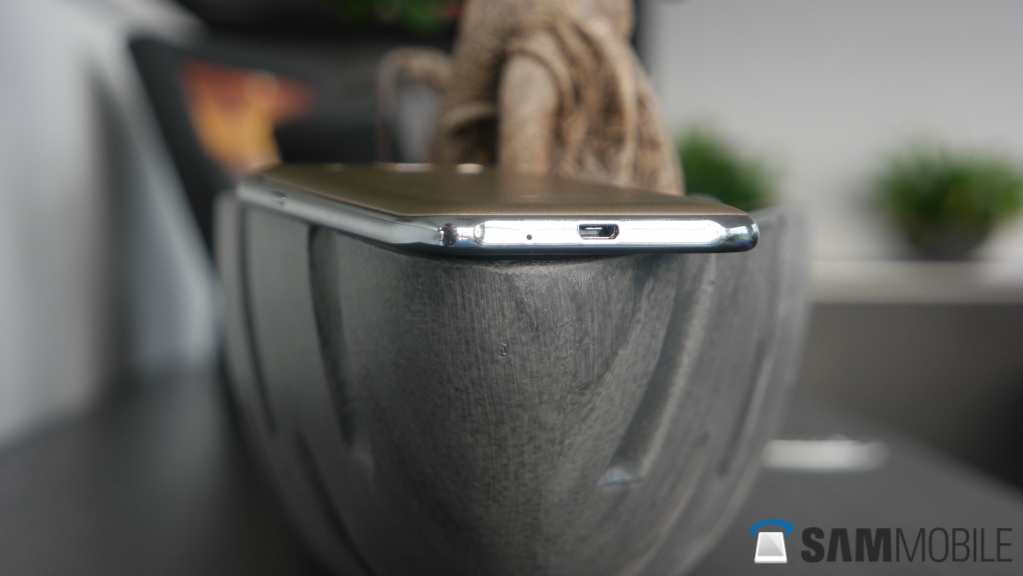
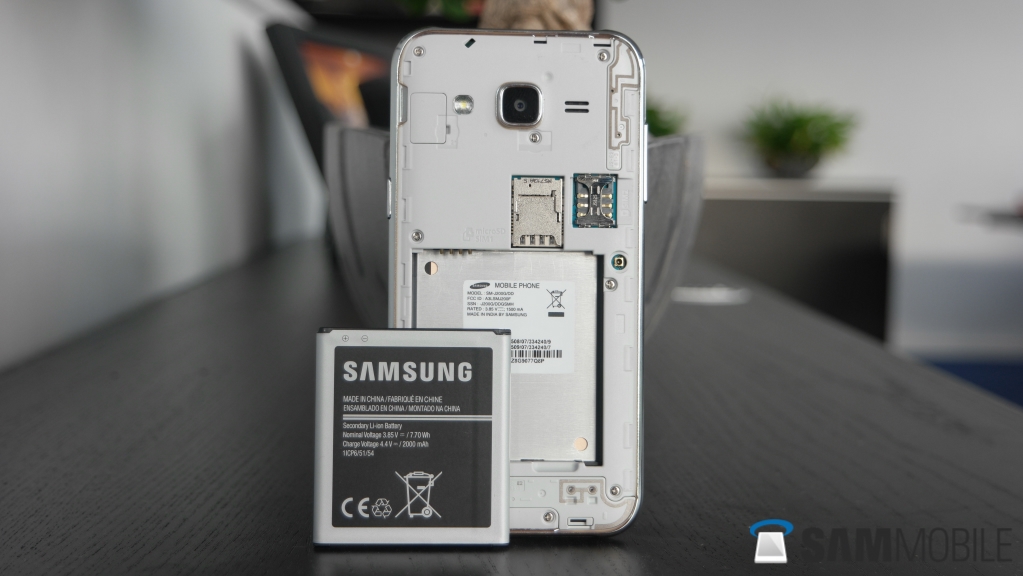
Despite all its achievements in the mobile industry, smartphone design isn’t one of Samsung’s strong suits. The Galaxy J2 looks as average as a smartphone can look, with a rounded design and a thick faux metal rim that stands out like a sore thumb. The phone feels okay in the hand thanks to the soft-touch back panel, which is removable and gives you access to the battery, two SIM slots, and a microSD slot.  That faux metal rim is the main source of the ugliness here, and we have no idea why Samsung couldn’t have at least made it a bit thinner.
SAMSUNG CSC
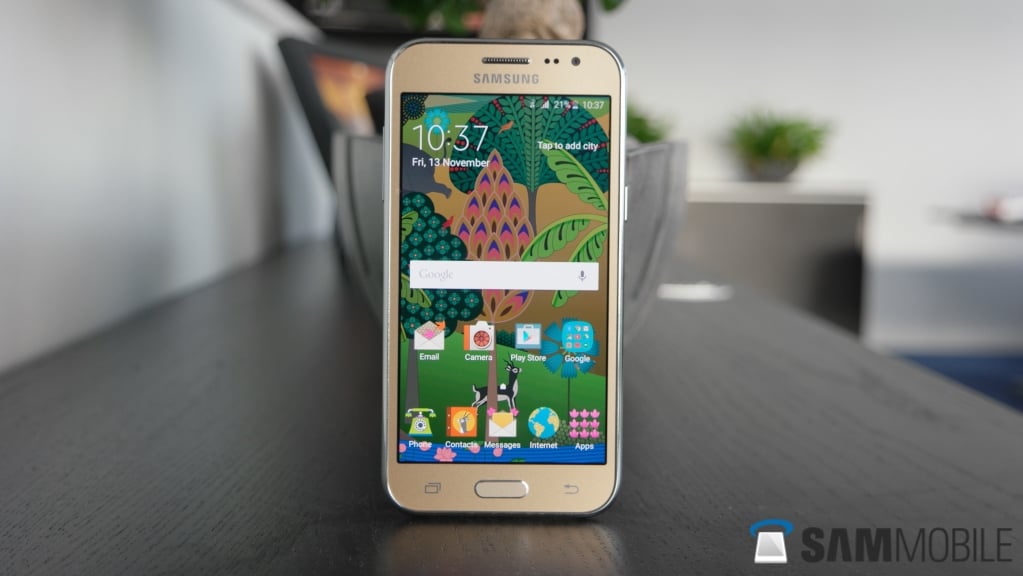
On the front of the phone are the navigation keys (a hard home button and two capacitive non-backlit back and recent apps), the earpiece, proximity and front-facing camera sensors, and the Samsung logo. Volume buttons are on the left, the power button is on the right, the primary microphone and microUSB port are at the bottom, and a 3.5 mm headphone jack is present at the top. Around the back we see the 5-megapixel primary camera in the center, with an LED flash and loudspeaker grille on each side. Near the bottom is the 4G DUOS logo; the J2 supports 4G only on one SIM, with the second SIM slot only supporting 2G networks.
Again, nothing about the Galaxy J2′s design looks like any meaningful effort was put into it. That fat rim around the device is something we wish Samsung would just do away with, and a bit of focus on the looks of its devices could help the company do slightly better in this segment of the market.
SAMSUNG CSC

Display

The Galaxy J2 features a 4.7-inch Super AMOLED display, with a resolution of 540×960 pixels (qHD). Phones priced so low don’t usually offer a great viewing experience, but the Galaxy J2 defies that convention thanks to its Super AMOLED display. OLED displays are intrinsically more attractive than LCD displays, and as a result the Galaxy J2 doesn’t disappoint. The screen has a lot of contrast, gets really bright (especially when you enable the Outdoor mode), and shows very deep blacks.
SAMSUNG CSC
Viewing angles are good as well, though you do have a bit of color shift when you tilt the phone to an angle and then look at the display. The display isn’t very sharp, since the qHD resolution only equates to around 230 ppi of pixel density, and the Galaxy J1 actually has a sharper display because it only measures 4 inches. For the price this is forgivable though, and the advantages of the AMOLED panel make up for the not-so-high screen resolution.
Oh, and in case you were wondering, the Galaxy J2 doesn’t feature an auto-brightness option, something that is missing on higher priced budget Samsung phones like the Galaxy J5 and Galaxy J7 as well. The Outdoor mode (accessible from the notifications shade) helps in bright daylight, but Samsung really needs to understand that removing the auto-brightness feature is one of the last things it should do when looking at how it can reduce the price of a smartphone.
Here’s a detailed analysis of the Galaxy J2′s display.

Cameras

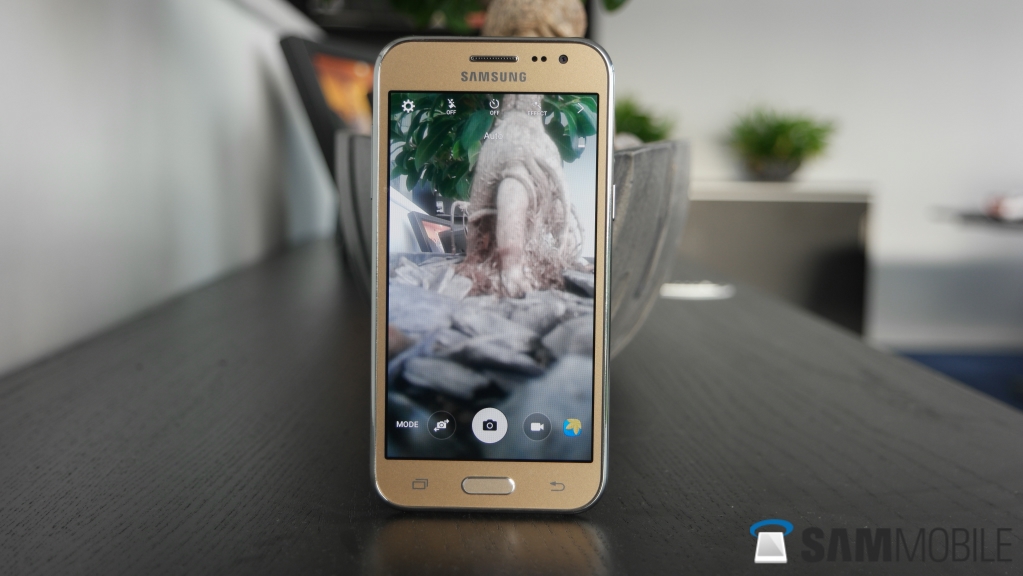
The Galaxy J2 comes with a 5-megapixel autofocus camera at the back, and a 2-megapixel camera at the front. The rear camera’s performance is at par with cameras found on devices in the sub-$150 price range, which is to say it’s not very good. Images aren’t very sharp, with dull colors and noticeable noise indoors. In low-light conditions the camera gets severely limited, and it can take a couple of seconds to get proper focus on the subject before a picture gets captured. Video quality is unimpressive as well, with a lack of detail very prominent in pretty much every scenario and noticeable shake.
SAMSUNG CSC
Selfies were a highlighted feature on the Galaxy J1, and it’s the same for the Galaxy J2 as well. Surprisingly, the front camera is better than the one on the back. Despite the low-resolution sensor, the pictures it takes are pretty sharp, at least when you compare it to the rear camera. Color reproduction is also pretty good, though the Super AMOLED display does help in adding to the images’ charm. Noise control is also done well, and the front camera’s performance is good enough for posting images to social networks like Facebook and Instagram.
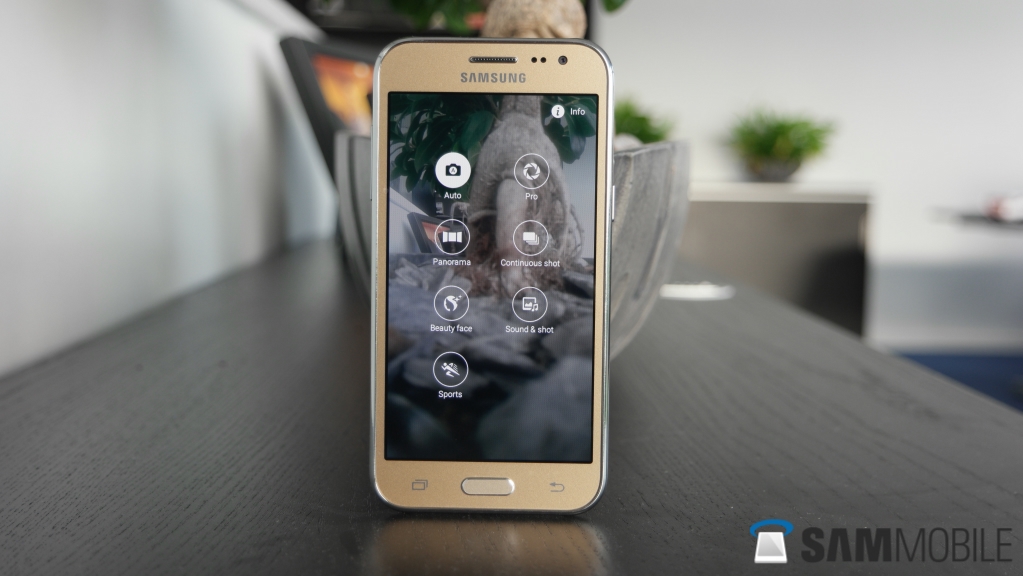
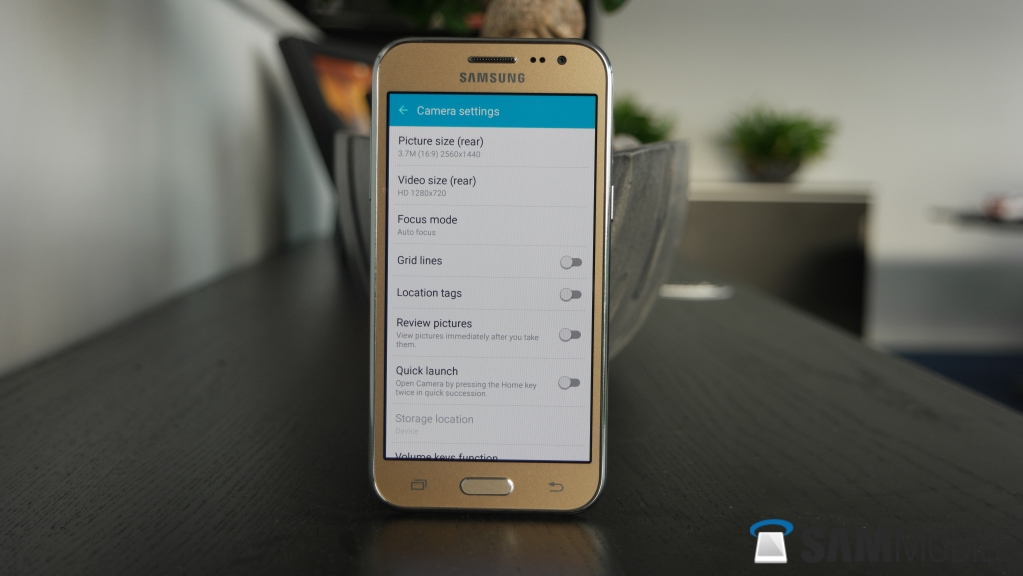
The Galaxy S6 feature that allows you to launch the camera app from anywhere by pressing the home button twice in quick succession is available on the Galaxy J2, though it’s disabled by default. Quick access to the camera is one of the top reasons for this shortcut to exist, but most of the time the phone can’t launch the camera app quickly enough because of the not-so-powerful hardware inside (which we will talk about after the software section.)
Check out a few camera samples below.
20151113_111142
20151113_111155
20151113_111149
20151113_111249

Software

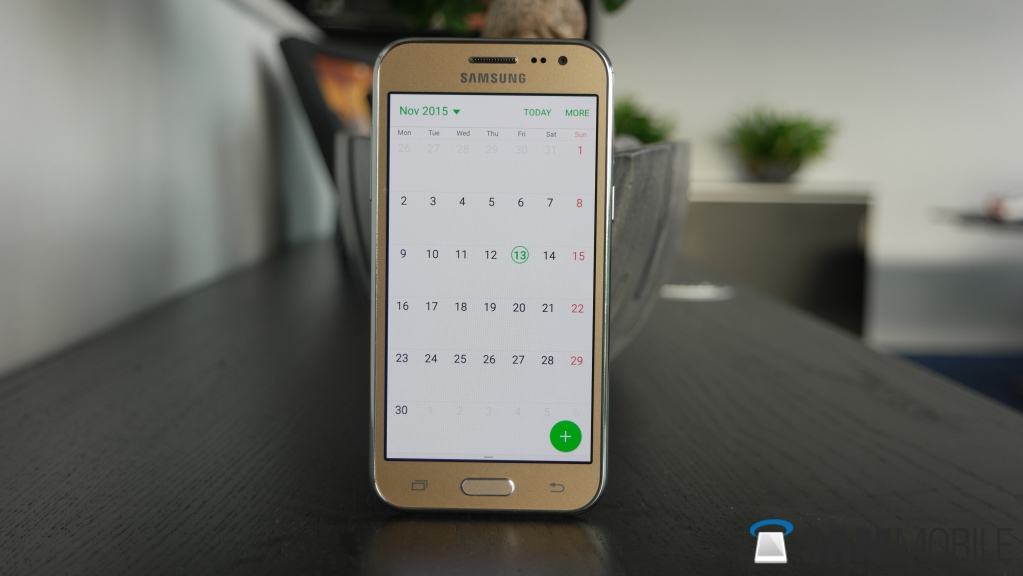
The Galaxy J2 runs Android 5.1.1 Lollipop, with the newest version of Samsung’s TouchWiz UX on top (the one that debuted on the Galaxy S6 and S6 edge earlier this year.) If you’ve used a Samsung smartphone before, you will feel right at home when you pick up the J2. Samsung’s user interface is the most intuitive in our opinion, especially now that the company has started cutting down on unnecessary features. That’s not to say you don’t get a lot of additional functionality over what you would find on a device that runs a stock version of Android, but none of the added stuff is in your face.
SAMSUNG CSC
Ultra Data Saving Mode is one feature that is exclusive to the Galaxy J2 (and to the Tizen-powered Z3.) This feature helps you save on data costs by compressing all incoming and outgoing internet traffic, and allowing you to limited data usage on a per-app basis. It’s certainly useful if your data plan doesn’t give you a lot of data, and its implementation across the operating system means you can drastically reduce the amount of data you use up everyday.
The Galaxy J2 also supports themes, but sadly there is no option to install additional ones over the ones that come pre-installed. This might be a limitation because of the qHD display resolution, as theme makers will have to adapt their themes to support this particular resolution, a task they might not be ready to undertake given the Galaxy J2 is extremely limited in terms of availability. Of course, support could be added later on as more qHD smartphones from Samsung become popular, but at this point you will have to make do with the rather unimpressive pre-installed themes to freshen up the software’s look.
SAMSUNG CSC
The J2 doesn’t come with Samsung’s proprietary music player either, an omission that can be seen on all Galaxy J devices, so you will have to make do with the Google’s Play Music app. But other than this, you get most of the features you get on costlier Samsung devices, including features like Download Booster.

Performance

This is the part where the Galaxy J2 brings the biggest improvement over the Galaxy J1. Partly because of the optimized version of Samsung’s TouchWiz UX, the Galaxy J2 performs adequately most of the time. There are a few stutters here and there, notably in the app opening animations and when you expand notifications on the lockscreen, but otherwise the J2 doesn’t suffer from the performance issues of its predecessor. Apps launch rather quickly, though there was sometimes a noticeable lag when switching between apps.
SAMSUNG CSC
When it comes to gaming, the entry-level nature of the J2 becomes noticeable. Temple Run 2 ran fine, but Angry Birds 2 didn’t do anything except show a blank screen, indicating compatibility issues with Samsung’s new quad-core Exynos 3475 chipset. Also, like other low-end Samsung devices, the J2 failed to download any high-end game (like Asphalt 8) due to the very low internal storage, so we were unable to test those out.
Overall, the Galaxy J2 performs slightly above average for the hardware it carries. It’s good for basic usage that includes social networking, some browsing, and a bit of basic gaming, but if you’re a demanding user the Galaxy J2 won’t hold up too well.

Battery

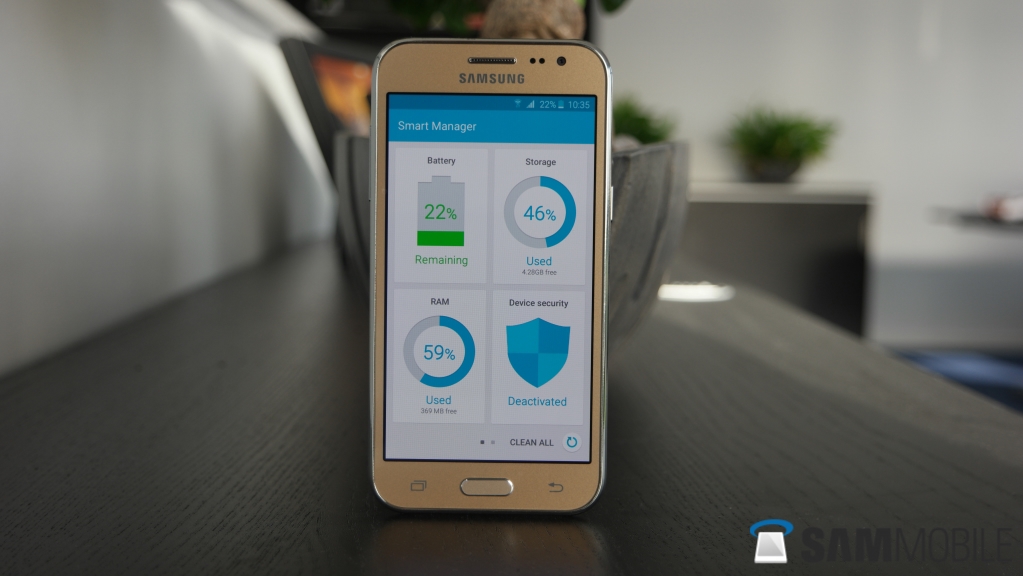
The Galaxy J2 comes with a 2,000 mAh battery, which is slightly larger than the 1,850 mAh battery found on the Galaxy J1. The hardware might not be too demanding - 2,000 mAh batteries aren’t exactly large enough for everything a smartphone is subjected to today, but battery life on the J2 isn’t bad. With general usage involving some calls, browsing, WhatsApp and three email accounts syncing all day, the phone was able to make it through the day easily. Heavier usage, especially when taking a few images with the camera, reduced the phone’s endurance by a considerable amount, but it still managed to get through an 8-hour work day with aplomb.
SAMSUNG CSC
That said, battery life is nowhere near as good as that of the Galaxy J5 or Galaxy J7, both of which are higher-end devices in the series and benefit from battery capacities often seen on flagship smartphones. Both the Galaxy J5 and J2 could go into the second day before needing a charge, and it’s disappointing to see Samsung isn’t maintaining the same battery performance on all phones in the lineup.
Like every other smartphone from the Korean giant today, the Galaxy J2 comes with the Ultra Power Saving Mode feature. Ultra Power Saving Mode is basically a fancy name for an option that turns the phone into a feature phone of sorts. Almost everything gets disabled, including the display’s color output, to save battery. You can make calls, use WhatsApp or browse the internet and use a couple of basic apps like the calculator when this mode is on, and that’s about it. Wi-Fi and mobile data get disconnected when the screen is off to reduce idle drain, and all of it helps when you want to make every drop count.

Audio/Call Quality

The Galaxy J2 comes with a single loudspeaker at the back, like most Galaxy smartphones. The loudspeaker doesn’t get very loud, but sound quality is acceptable, with noticeable punch to the output. No, you won’t be listening to music on this loudspeaker very often, and overall it’s pretty much average. Expect to miss a few calls when the phone is in your pocket and you’re in a crowded place, and don’t expect to be able to easily listen to what the other person is saying when you put a call on the loudspeaker.
Speaking of calls, call quality on the Galaxy J2 is also just average. Both parties on a call can listen to each other well, but there is noticeable hiss sometimes when the network signal isn’t strong. The phone was able to latch on to mobile networks quite well for the most part. As is usually the case, it wasn’t too capable of providing a good signal in low coverage areas, but that’s a common problem across the budget smartphone market.

Wrap Up

The Galaxy J2′s best feature is the Super AMOLED display, considering its low price tag, even though we could have done with higher resolution. Performance is also good for the most part, but there’s pretty much nothing else here that can make the Galaxy J2 an instant recommendation.
It’s disappointing, to be honest, especially since the Galaxy j5 and Galaxy J7 are so much better, making the Galaxy J2 (and the Galaxy J1) look like an afterthought. The J2 is by no means a bad phone for the price a major manufacturer like Samsung is asking you to part with, but we just can’t help but feel the company isn’t offering much in the ever growing budget smartphone market. There are a lot of better options available in the J2′s target market, some of them even priced lower, and we hope Samsung can start making budget phones that don’t make you feel like you are sacrificing on most of the important aspects of a smartphone.

HTC 10 review

HTC 10 Battery

OUR VERDICT

It's a hard phone to rate on first impressions – HTC has put all the right bits in here, but I felt the same way with the One M9. However, the brand seems to have addressed the foibles and appears genuinely excited by the new 10.

FOR

  • Amazing audio
  • Great design
  • Battery improved

AGAINST

  • Camera not impressive
  • Boomsound not great
  • Slight bugs still in system
If there's one thing you can say about HTC, it's that it's been a victim of its own success.
The One M8 was one of the greatest phones ever made, one that I'll still dust off from time to time now just to get a feel for it once more. It was design perfection, filled with genuine innovation and offered a great identity too, standing out well from the Android crowd.
  • Buy HTC 10 (32GB) at Amazon for $629.71
The trouble was, that phone was already building on the great HTC One, which started the 'amazing design' trajectory in flagship smartphones that HTC is now famed for. So where did HTC go next? What was the next big innovation, the next great thing that this underdog in the smartphone world was going to bring?
Well, it didn't happen on the One M9, that's for sure. The brand panicked, stuffed the best components into an all-too-familiar shell and hoped the big numbers would make it a success. It wasn't.
HTC 10 Performance


This time around, things were going to be different. For the all-new HTC 10 I was told that the brand took things back to basics, made the changes it needed to and focused heavily on making the phone useable and a pleasure to mess around with as before.
But does the HTC 10 impress? Is this the return to true innovation from a company that used to be unafraid to take risks, a reboot back to the winning ways?
Before we get into that, let's take a look at what the phone looks like on paper. It's got an all-metal body, thankfully doesn't go down the same iPhone-a-like design as the One A9 from 2015, and doesn't just stuff in tech for the sake of having a higher spec.
If you're lucky enough to live in the UK, get in there early and apply discount code 'HTC10' to get 10% off, giving you a price of £512.99.
HTC 10 Camera


It's got the new Qualcomm Snapdragon 820 chipset, loads of RAM, a much more refined camera and – with contract pricing starting at around £38/US$23/AU$75 per month – it's going to be competitively positioned, coming in similar to or in some cases a shade below the Samsung and Apple prices. So, that sounds all great, right?

Key features

One of the most irksome features of the HTC One M9 was…well, there weren't really any features to talk about. The same BoomSound speakers were back, firing audio forwards into your face, and the camera was just a 20MP effort that took some okay pictures; not terrible, but nothing you'd tell your friends about down the local watering hole.
In fact, it was just the design that made it worth checking out at all, that combined with HTC's special sauce.
This year, thankfully, there's a lot more to talk about, starting with the efforts made to improve how the phone feels to use. It's got a much lower latency compared to the earlier models, which means the response under the finger is a lot more impressive.
In fact, the constant chat in our briefing about the phone was about 'tuning', that HTC had gone further than any other brand in making the HTC 10 a phone that will impress the second you glide a finger across the screen.
Let's drop out for a second and talk about the name: it's not the HTC One M10, but simply the HTC 10. Apparently, this represents the best ever, the top of the pile, the maximum score you can get in gymnastics.
To me, that sounds like this is HTC's last ever phone. But you can bet there'll be some 'turn it up to 11' tag lines next year when the HTC 11 pops up.
HTC 10 Design


Anyway, back to the 10. The screen is also upgraded from the previous model, using Super LCD 5 and boosting the pixel count to QHD resolution, offering 564 pixels per inch, to push up the sharpness significantly.
The camera is dropped in terms of the megapixel count, down to 12MP with a 4:3 resolution (sound at all similar to any other top-end phones on the market?). HTC tells me this is something actually requested by photographers, and given it's put such a big effort into making the camera as good as it could be, it's believable that HTC would listen to them.
The 10 has also been given the best DxO Mark on the market of 88, which HTC says means it's claimed the crown of 'best camera in a smartphone'. It doesn't at all – that title was previously held by Sony and the Xperia Z5, and there's no way those were the best cameras on the market by any stretch of the imagination.
The camera, which supposedly has blink-and-you'll-miss-it autofocus thanks to the second-generation laser autofocus on offer, also comes with 4K video recording combined with 24-bit sound, so you'll get professional-grade videos when you're out at a gig and completely missing the chance to enjoy the artist you paid so much to see.
HTC 10 Camellia Red smartphones


Talking of the audio, that's the other area HTC's been putting a big effort into. The two front-facing speakers, which looked so iconic on the front of the recent One range, are gone, with two speakers now firing out the high end and bass tones separately.
They also point in different directions, but despite having separate amplifiers they work in concert to, it's claimed, give amazing sound without headphones (spoiler alert: they don't).
The headphone element is important though, as HTC has taken the bold step of not only making the HTC 10 Hi-Res Audio Certified, but has also bundled in some high-end headphones with the handset, so everyone has access to the improved tones.
These aren't cheap to make, so it's good to see HTC taking a hit on its margins to give something back to its users. You seeing this, Tim?
And a special word for the interface, which HTC is bragging quite heavily about – and it's anything but heavy. The brand has worked with Google to 'reboot Android' and make something cleaner, more easy to use and upgrade, ridding the phone of pointless duplicated apps in the process.
The aim is for the project to eventually find something that all brands will use, leading to an end of the skins that sit atop LG, Samsung and Sony phones despite them all using the same base software. Will that happen? Would it be a good thing for HTC? Who knows – but it's good that someone's trying.